When Plans Go Wrong

I heard about a situation the other day that I’d like to share with you to get your thoughts:

It seems a 62 year old woman, I’ll call her Susan, had been in the hospital for a few days due to vertigo.  She would feel the room spinning when she moved her head in certain positions.  It was so bad that she could hardly walk let alone drive, and she lived alone.  The vertigo was also accompanied by nausea and vomiting.  While in the hospital she was given a medicine, meclizine, that controlled her symptoms.  Her doctor discharged her with a prescription for the medicine.  He also wanted a home health nurse to visit her several times a week and a physical therapist to come to her home to give her some treatments that usually help control the symptoms as well.  Finally, her doctor wanted her to come to his office a week after discharge from the hospital to make sure she was progressing.  All in all, it sounded like a great Discharge Plan.  The trouble is – it just didn’t happen.

First, since meclizine is available over the counter, her insurer wouldn’t pay for it even though she had a doctor’s prescription for it.  Next, though she went home on a Friday, by the following Wednesday she had yet to have a visit from the home health nurse.  When Susan called the nursing agency to find out why the nurse hadn’t visited, she was told they had not received an order faxed to them from the attending physician.  And because the nurse was going to arrange for the physical therapist, she had not had any physical therapy either.  Susan called the physician’s office when she learned of this, but hadn’t received a call back from the doctor after several days.  Finally, because she didn’t get the medicine that was prescribed she was feeling worse since coming home and couldn’t drive herself to the doctor’s office for her Thursday follow up appointment.

Has anything like this happened to you or someone you know?  If you were Susan, what would you have done differently?  Please post your thoughts & comments.

For Your Health – Dr. Bob


Decoding Nutrition Labels

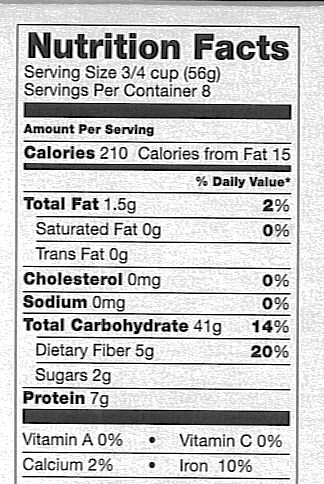
Nutrition Label - Whole Wheat Penne PastaAt your grocery, one of the most beneficial things you can do to assure your weight loss success is to read the Nutrition Labels of the foods you consider buying. Let’s talk a little about the kind of information that these labels provide.

The example shown here is from a box of whole wheat penne pasta. The first thing to notice is the definition of Serving Size since all the other information is related to 1 serving. Here we see that 1 serving of this pasta is 3/4 cup. It also tells us that there should be approximately 8 servings in this box of pasta. All the other information is based upon 1 serving, so if you eat 1 serving of this pasta, you will consume 210 calories and 15 of those calories are from fat.

As you continue looking at the label you’ll see the content of Fat, Cholesterol, Sodium, Carbohydrate and Protein. Two of the kinds of fats are listed separately, Saturated Fat & Trans Fat. These are the two kinds of fat that you should avoid as much as possible because of their association with heart disease. In this example they are 0, so we know that the other kinds of Fat, Monounsaturated or Polyunsaturated must account for the 1.5 grams that are contained in this food. Another positive for this food is the absence of Cholesterol & Sodium. The Carbohydrate content is somewhat high at 41 grams.  For a 1200 calorie meal plan, the recommended Carbohydrate intake is approximately 150 grams.  That 3/4 cup contains a lot of complex carbohydrates, since the Dietary Fiber and Sugar components are relatively small at 5 and 2 grams respectively. For a person who has an elevated amount of triglycerides in their blood, lowering their Carbohydrate intake will also improve their triglyceride level.

Finally, you can see that the Protein content is 7 grams and that this pasta contains some Calcium & Iron. The percentages that you see are the percentages of the daily recommended values where known for each of these for someone on a 2000 calories meal plan. So, since most people who are trying to lose weight have a recommended daily caloric intake less than 2000 calories, these amounts actually represent a greater percentage of the recommended amounts for them.

As you can see there is a lot of information on these labels to help you make healthier choices.  And isn’t that what eating healthier is all about?  It will take time for you to use this tool as you make your choices, but it will be worth it.  Before you know it you’ll know exactly what to look for and how to use the information to help you reach your goal.

For Your Health – Dr. Bob


Shopping Healthy

You can’t eat what you don’t have in your refrigerator or pantry.  This obvious truth is the foundation for developing and using a meal plan that will help you attain your weight loss goal.  Since food shopping is so critical for your success, I have listed a few tips to help you when you head to the grocery:

  • Make A List & Stick To It – Shopping smart starts with planning. Before you go to the grocery, make a list of the foods you need to get. By sticking to the list you will avoid making poor food choices.
  • Don’t Shop Hungry – Another tip is to avoid going food shopping when you are hungry. You are more likely to impulsively buy high caloric, unhealthy “junk” foods then. So take your list after you’ve had a meal, and you’ll be more likely to make healthier food choices
  • Read Nutrition Labels – Comparing nutrition labels is most helpful in choosing between one or more similar products or among brands of the same food. If you have high blood pressure or heart failure, you should minimize your sodium intake, so you can use the information on the Nutrition Labels to choose foods with lower Sodium content. If you have a high level of cholesterol in your blood, use the information to choose those foods lower in Cholesterol, Saturated Fat and Trans Fat to lower your blood cholesterol as well as your risk for heart attack and stroke.

Since knowing how to read Nutrition Labels is so important to choosing the healthier foods, I’ll talk about that in the next post.

For Your Health – Dr. Bob


Medication Basics – Part 2

I want to talk a little about how to get the most out of your medications and save money in the process. 

  1. It should come as no surprise that your medicines won’t work if you don’t take them properly.  Properly means routinely as they were prescribed without missing doses.  For antibiotics it is critical to take them all just as your doctor has prescribed.  Stopping when you start to feel better will leave the infection incompletely treated and likely to recur.  Since different infections usually require different antibiotics, the antibiotics you save with incomplete treatment may not be effective for your next infection.  There is nothing to be gained by not taking all the antibiotics prescribed.
  2. Another point needs to be made in regard to taking medications that control certain conditions such as hypertension, diabetes, elevated cholesterol or asthma.  Your doctor will monitor your condition’s response to the medication he has prescribed.  If you do not take your medicine as prescribed, and do not let him know, he will assume the state of control of the condition is the result of the regimen he has prescribed.  So if your blood pressure is still high, he may either increase the dose of the current drug or prescribe another.  In either case, you will be paying more for the treatment and the proper dosage will be uncertain.  If you take the increased dosage as prescribed, it could lower your blood pressure too much.  Also, the increased dosage can make side effects more likely.
  3. If your health plan has a mail order pharmacy benefit for your chronic medications you should check it out.  Usually you’ll get a discount, such as paying a two-month copay for a three-month supply.  However, check with local retailers that may have especially low prices for some of the more common medicines.
  4. Another way to save money on your prescriptions is to ask your physician to prescribe generic medications whenever possible.  For most drugs where there is a generic available, it is just as effective as the brand name and much less expensive.
  5. It’s important to take your medicines as prescribed.  If you have trouble remembering them, you may need to link taking them to certain daily activities.  For instance, when you are taking a drug twice a day it makes sense to take one dose in the morning with breakfast & the other with dinner.  First, of course, check with your doctor or pharmacist that they can be taken with meals.  Other people use an alarm set on their Smartphone as a reminder.  People who take several medications, often use a pill box with seven compartments that correspond to the days of the week to help them keep on track with their medications.
  6. Another good policy is to use one pharmacy for all your medications so they can check more easily for drug interactions.  Many pharmacies have software built into their systems to screen for these potential problems.
  7. Finally, make a list of your medications & dosages to keep in your wallet.  If you are ever in an emergency situation and are unable to speak, the emergency personnel will check it and use it to guide your treatment.

For Your Health – Dr. Bob